
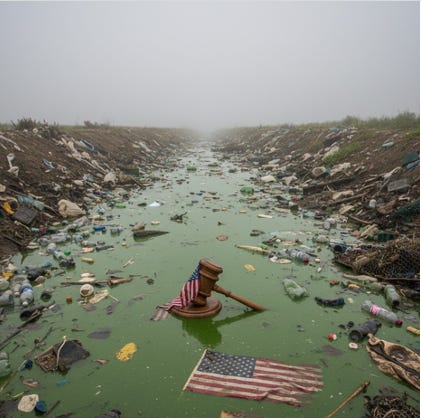
Contaminated

This January, the National Park Service removed the word “slavery” from an exhibit at Independence National Historical Park in Philadelphia.
The site sits in the shadow of the Liberty Bell. It marks the President’s House, where George and Martha Washington lived—and where they enslaved human beings. For more than a decade, the exhibit said so plainly.
Then it didn’t.
The directive came from Washington. From Trump. A March 2025 executive order instructed federal agencies to eliminate what it called “corrosive ideologies” that disparage American history. The Interior Department complied. Context was stripped. Language softened. Slavery disappeared.
The action is lawful.
Lawful by executive order. Lawful by Interior Department directive. Lawful by Park Service compliance. Each step authorized. Each step procedural. Each step sanitized. The result: the erasure of any mention of slavery from a national site.
But does that make the order right?
At the opening of Black History Month, the federal government used its legal authority to remove a historical truth from a public space dedicated to freedom. This is the blueprint of contamination: using the mechanics of the state to bleach the conscience of the country. The erasure is now being challenged in court. No statute has been struck down. No final ruling has been issued. The order worked exactly as designed—maximizing executive authority while deferring accountability.
This is not new. What is moral has long been contaminated by what is legal, until legality itself becomes a substitute for conscience. American law has repeatedly outrun morality—and dragged it backward. From the country’s founding, slavery was lawful. It was enshrined in the Constitution. It was defended as property rights. It took a civil war and a constitutional amendment to admit what morality had known all along. Until then, the legality of slavery functioned as permission.
Segregation followed the same path. In 1857, Roger Taney’s Dred Scott v. Sandford decision declared Black Americans had “no rights which the white man was bound to respect.” In 1896, Plessy v. Ferguson attempted to make separation respectable. Separate but equal. Constitutional. It took generations of resistance before the law caught up and passed the Civil Rights Act of 1964—a milestone in anti-discrimination relief that recent court rulings and perverse legislation now threaten to dismantle.
Interracial marriage was a felony in many states until Loving v. Virginia said otherwise.
Women’s bodily autonomy was recognized as a constitutional right to privacy and liberty in Roe v. Wade—until Dobbs v. Jackson yanked it all away.
The contamination of law and morality is not accidental. The language of law—clever, antiseptic, originalist—has repeatedly been weaponized to justify the unjust. Torture was legalized through Office of Legal Counsel memoranda. John Yoo’s deliberately dense prose turned waterboarding from brutality into policy.
In September 2025, the White House issued a Presidential Memorandum titled Countering Domestic Terrorism and Organized Political Violence. The Trump regime redefined activities protected by the First Amendment—protest, assembly, community defense—as domestic terrorism. The same regime would now police these “outlawed” ideologies itself:
“…anti-Americanism, anti-capitalism, and anti-Christianity; support for the overthrow of the United States Government; extremism on migration, race, and gender; and hostility toward those who hold traditional American views on family, religion, and morality.”
With that, the Trump regime made itself interpreter, enforcer, prosecutor, judge, and jury. Dissent became suspicion. Protest became threat. The contamination was complete: legality no longer restrained power—it authorized its excesses. Don Lemon is caught in this legal snare. By the memorandum’s logic, anyone whose foot hit the streets to protest ICE in Minneapolis is a terrorist.
So far, this twisted legality is functioning as intended. After Renee Nicole Good was killed by an ICE agent on January 7, Vice President JD Vance described her actions as “classic terrorism.” Donald Trump went further, falsely claiming she had “violently, willfully, and viciously” attacked an ICE officer. Alex Pretti—shot at point-blank range—was posthumously labeled a “domestic terrorist” by Stephen Miller, Kristi Noem, and Kash Patel. Gregory Bovino, then the public face of the Minneapolis ICE surge, claimed Pretti intended to “massacre law enforcement.”
Federal ICE agents in Minnesota have killed citizens and left neighborhoods living in fear—actions the administration has retroactively justified through the language of threat. When Tom Homan replaced Bovino, he acknowledged growing fear—but not the public’s. He was speaking of the fear his ICE agents were feeling.
“Some of these people have been in theater for eight months.”
Theater?
This is the lexicon of the contaminated state. By using the military term “theater” to describe an American city, the government performs a verbal sleight of hand. It transforms a neighborhood into a battlefield and a citizen into an enemy insurgent. This is no longer civil policing; it is domestic militarization, driven by the xenophobic-Carl Schmittian-nationalist obsessions of Stephen Miller, enforced by Kristi Noem, and directed by Donald Trump.
Lawful? Rightful?
At this moment, the fate of 353,000 Haitians living here legally is hinging on a single district court judge holding up Noem’s attempt to terminate their Temporary Protected Status. Her motivations scream from her TwitterX posts:
“I am recommending a full travel ban on every damn country that’s been flooding our nation with killers, leeches, and entitlement junkies. Our forefathers built this nation on blood, sweat, and the unyielding love of freedom—not for foreign invaders to slaughter our heroes, suck dry our hard-earned tax dollars, or snatch the benefits owed to AMERICANS. WE DON’T WANT THEM. NOT ONE.”
When twisted legality is mistaken for moral certainty, power learns it can do almost anything—as long as it is written down carefully enough.
Minnesotans aren’t having it. The sparks ignited by the killing of Renee Good and Alex Pretti have turned into roaring flames across the country. A vast movement is growing.
This week began—as so many weeks of the Trump regime do—with alarms blaring. The John F. Kennedy Center for the Performing Arts announces a two-year closure for renovation. Trump, who demanded his name appear alongside JFK’s, dismisses the memorial as “tired, broken, and dilapidated.”
In his New York Times opinion column, David French warns:
“A president who doesn’t care about the law, who commands an obedient Congress and is supported by a radicalized base of tens of millions of people who believe his lies, represents a threat to the next election.”
The following day brought this headline—as if on cue: Trump Calls for Republicans to “Nationalize” Elections.
Also this week ProPublica revealed the names of the two ICE agents who killed Alex Pretti—names withheld from Congress and from state and local law enforcement by the Department of Justice. In a system of contaminated justice, anonymity becomes a legal asset. Shielding identities isn’t about safety; it is about ensuring that the state’s violence remains faceless, nameless, and therefore protected.
Note from the ProPublica Editors:
We believe there are few investigations that deserve more sunlight and public scrutiny than this one… The policy of shielding officers’ identities, particularly after a public shooting, is a stark departure from standard law enforcement protocols … Such secrecy, in our view, deprives the public of the most fundamental tool for accountability.
The killers are no longer anonymous. Moral outrage is reasserting itself against legal justifications for the indefensible. Even Ammon Bundy, the country’s most notorious militia leader, said the actions of ICE “clearly look like tyranny.”
There is a moral arc to this dilemma. But the arc does not bend on its own. When law repeatedly fails morality, something eventually gives—either the public’s patience or the system’s legitimacy. We are seeing that unfolding in real time now.
The government can erase words from public exhibits. It cannot erase the burden borne by those who live with the consequences. The true spirit of the law belongs to those who defend it from moral contamination. Today, that defense is being mounted in courtrooms across the country by legal professionals holding the line where institutions are failing. They are not rewriting history. They are refusing to let law be used to launder injustice. Their work is exacting and deliberate—but it cannot succeed without the public. Law does not correct itself. It moves only when “we the people” force it back toward its moral purpose.
These are some of the Courtside Warriors who have been fighting to save democracy—and winning. Sign up for their newsletters. Support them if you can.
Democracy Forward, Public Citizen, Protect Democracy, Democracy Docket, League of Women Voters, Campaign Legal Center, ACLU, the NAACP Legal Defense Fund, Citizens for Responsibility and Ethics in Washington, Brennan Center for Justice, Common Cause There are many more.
The Courts—Especially the Supreme Court—Won’t Save Us.
Nevertheless, we’ve got to support our Courtside Warriors any way we can.
Just Security Litigation Tracker
On January 29, 2025 there were 24 legal challenges
to Trump Administration actions.
As of February 4, 2026, there are now 608…and counting