
Dominion

Brett wanted a do-over.
More accurately, Associate Justice Kavanaugh wanted a country club mulligan. When a 6-3 Supreme Court majority stopped the Trump administration from deploying federalized National Guard troops in Chicago—and likely in Portland and L.A.—Brett took the opportunity to “clarify” a previous concurrence o his in another case about ICE detentions being minor inconveniences.
“If the stop turns out to be a mistake,
the individual will be free to go after the brief encounter.”
Brett was being naive at best, cynical at worst. He either ignored or discounted videos of violent and often mistaken ICE stops that, for some, have played out over days. That’s why he grabbed the opportunity to “correct” his comments that raised such a stink about what are now derisively called “Kavanaugh Stops.”
But there is a deeper groove underpinning Brett’s legalisms. While he speaks the language of judicial restraint, his grip on the “Unitary Executive” provides legal scaffolding for a far darker structure. Whether he is a conscious disciple or merely a useful architect, Kavanaugh is effectively handing the keys of the law to an executive who views laws as mere suggestions. Make no mistake: Kavanaugh was still enabling ICE’s dominion over communities of color but urging them to exercise restraint—as if Noem, Homan, and Bovino would give a shit.
“Reasonable suspicion means only that immigration officers may briefly stop
the individual and inquire about immigration status.”
Briefly!
Brett’s feckless attempt at a judicial “sorry-not-sorry” just before the holidays didn’t work. DHS and ICE didn’t care then. They still don’t—which brings us to the resurgent influence of a Nazi political philosopher. Stick with me. There is a connection.
“Sovereign is he who decides on the exception.”
—Carl Schmitt, Political Theology, 1922
Carl Schmitt’s bleak political theories have become the lodestar for vast segments of Silicon Valley, the New Right, post-liberal scholars, and likely the Trump regime’s chief policy engineer, Stephen Miller. All of these camps have one thing in common: they seek to tear down the liberal order and assume authoritarian control. They do so by clearly defining who is a friend and who is an enemy. That is one of the core principles of Schmitt’s anti-liberal worldview:
The Friend-Enemy Distinction: A group can only become a political entity when it identifies an existential threat to its way of life.
The State of Exception: True power isn’t found in following laws or a constitution, but in the unilateral power to suspend them during an “emergency”.
The Trade-Off: Liberal democracy is an “endless conversation” deluding societies and making them vulnerable to real enemies. Democracy must be annihilated in order to “save” civilization.
Sound familiar?
These tactics started within minutes of the presidential inauguration this year.
Identify enemies
Declare emergencies
Suspend laws and the Constitution
Seize power
“I have the right to do anything I want to do.
I’m the president of the United States.”—Donald J. Trump
“There’s no law, there’s just power.”—J.D. Vance
For Schmitt, history holds no hope for freedom and justice. It is forever threatened by chaos, civil war, or apocalyptic collapse. What prevents collapse is not law or liberal norms, but a sovereign power willing to decide who is friend and who is enemy in order to impose order. If the law must be suspended to achieve this, so be it—the sovereign decides.
Schmitt’s “political theology” is used extensively to justify unitary executive power. That should please conservatives on the Supreme Court, particularly Chief Justice John Roberts. In this country, Schmitt is regularly invoked to justify regime change—though not necessarily Trump’s regime. Ironically, at this moment, Trump is becoming nothing more than an annoying, afterthought. This is not a left wing fantasy. Trump’s regime is already being labeled as a failure by the accelerationist far right—lead by seminal Silicon Valley “Schmittian” Curtis Yarvin. Trump 2.0 may have sent out dozens of executive memos screaming about “emergencies” in order to justify lawless policies, but many have been magnificently checked by a cadre of aggressive courtside warriors.
But caution is in order. One failed regime change won’t stop the next attempt to pull down liberal democracy. The disciples of Carl Schmitt are not going to give up. For these zealots, this Nazi philosophy is an essential, cult-like worldview. We have yet to witness how the body politic will behave under sustained pressures coming from the right—rigging elections for one-party rule and authoritarian control built on hatred of the opposition. And we know that pockets of Schmittian sentiment are growing.
In Silicon Valley, Schmitt serves as a rallying point for Peter Thiel’s own political theology that “freedom and democracy are no longer compatible.” He frequently references Schmitt’s concept of the Katechon—a biblical force holding back the Antichrist and thereby delaying full apocalypse. Thiel uses Schmitt to argue that “sovereign” individuals or leaders must “break” the law, invoking the “state of exception” to save civilization from technological or social decay.
The New Right debased itself by crying out that we are threatened by Haitians “eating our cats and eating our dogs.” At least, J.D. Vance did. But this misbegotten fantasy belies Vance’s true intent. He is expanding the friend-enemy distinction beyond race. He is arguing that the virtuous Right must treat the decadent Left as an existential enemy to be defeated. There is no room for civic dialogue or policy debate. Vance will target anyone who disagrees with him or gets in his way.
Post-liberal scholarship championed by Patrick Deneen and Adrian Vermeule argue that the liberal state is the “enemy” of the traditional family and church. They promote the belief that a strong sovereign is necessary to direct society toward a common good. Allowing individual rights will tear the social fabric apart.
There it is. A chorus of voices arguing for the return of authoritarian rule—a return to a neo-feudal state where individuals are subjugated to a common good dictated by a ruling elite.
The worldviews of Carl Schmitt and Woodrow Wilson cannot coexist. Schmitt's hard binary of the existential enemy stands in stark contrast to Wilson's universal conscience and collective security.
Imagine that. Conscience. Collective security.
This is what we must all decide. Are we to be forever locked into tribal antagonisms? Can we achieve a global community?
Yuval Noah Harari offers a powerful counter-logic to the Schmittian resurgence. He warns that reducing politics to a raw power struggle between “us” and “them” is a retreat into a primitive biological reflex. He argues that our evolution from nomadic tribes to global civilizations was only possible because we learned to bypass the friend-enemy instinct in favor of complex cooperation built on shared, peaceful myths. We stopped seeing “others” as predators and started seeing them as partners in a massive project of imagined laws, imagined currency, imagined commerce. Without cooperation, we will be unable to solve global threats such as AI superintelligence, climate change, and human migrations—issues which transcend nativist nationalism.
In all of the camps of thinking about Carl Schmitt’s worldview, one primary question stands out:
Who has the credentials—and the right—to decide the course of humanity?
Fortunately for us, there is no consensus. Technocrats will call upon their brilliance and innovation. Theocrats will call upon the teachings of their “gods” for direction. Corporate elites will laud their abilities to enrich themselves at the expense of all others. There is no guarantee for a better world from any of these camps. The only sure bet is that whoever holds the power will have the authority to dictate the terms of life for everyone else—because they can. That alone convinces me that liberal democracy—as messy as it is—is the best way to go.
Our challenge recalls the fight against rising authoritarianism a century ago in the 1930s. In 2026, our job is to prove the Nazi Reich Minister of Public Enlightenment and Propaganda wrong:
“This will always remain one of the best jokes of democracy,
that it gave its deadly enemies the means by which it was destroyed.”
— Joseph Goebbels, “The Stupidity of Democracy,” 1930
We cannot be afraid to tackle the onslaught of AI-generated slop designed to overwhelm reality with emotionally charged rage bait and false narratives. We cannot cede truth to those who plot to destabilize trust in institutions, demonize opponents, and create the constant “emergency” atmosphere in which authoritarian “order” appears necessary—inevitable.
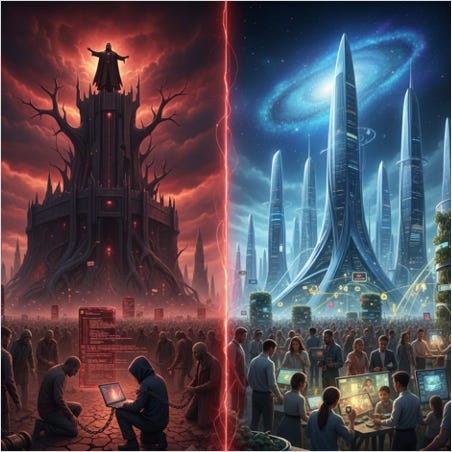
The choice is no longer between left and right; it is between two competing worldviews. On one side stands Sovereign Dominion—a world where power is validated by perpetual emergency—order imposed by attacking enemies and suspending law. On the other stands Civil Democracy—a fragile, noble project where power is validated by the consent of the governed and order is maintained through the difficult work of cooperation.
Which will it be?
Sovereign Dominion or Civil Democracy
Schmitt’s philosophy of “rule by exception” to our constitution and our laws is knocking at the door. In 2026, our answer will determine whether we remain a nation of laws or become a nation of elite whims.
It’s ours to decide—in the courts, in protest, in public opinion, and at ballot boxes across the country.
Happy New Year
These are some of the Courtside Warriors who have been fighting to save democracy—and winning. Support them if you can.
Democracy Forward, Public Citizen, Protect Democracy, Democracy Docket, League of Women Voters, Campaign Legal Center, ACLU, the NAACP Legal Defense Fund, Citizens for Responsibility and Ethics in Washington, Brennan Center for Justice, Common Cause, and many more.
The Courts—Especially the Supreme Court—Won’t Save Us.
Nevertheless, we’ve got to support our Courtside Warriors any way we can.
Just Security Litigation Tracker
On January 29, there were 24 legal challenges to Trump Administration actions.
There are now 552 and counting.
Wow. Who knew such recent history could tell us so much about the present attitude of anti-democracy thinkers? American democracy is not perfect by any means, but the dream still lives. Hope is still strong. Action at the polls will matter. I’m sticking with democracy.
Gorgeously constructed, and intellectually elegant, as always, Harry.
A couple of points. The least is in your "Schmitt's'political 'theology'" paragraph. If I understood you correctly, you meant led instead of lead.
Second, Peter Thiel thinks civilization should be saved from technology?
But finally, and perhaps most important, your title for this post was "Brett wanted a do-over." If I understood you correctly, your thesis is that Kavanaugh thinks the Supreme Court was wrong, and should reconsider its vote. The one that opposed blind right wing destructiveness and the themes you develop in this post. But to the extent that Kavanaugh thinks his usual clan/Klan failed to get it this time, what he's saying to them, by wanting, as you construct it, a do-over, is that they're morons who have no idea what any of this is about or what they're doing. Does he just think they guessed right all the other times, or that they were appropriately susceptible to his manipulating? He takes an exquisitely dim view of them, and of all of us. It doesn't bother him at all that he literally gets away with crimes, because during the clown's first term (clown 1.0), the FBI didn't trouble to investigate him properly. He sees no problem in sitting in on cases after he's already publicly complained about "liberals and Clintons." As if there remained the remotest chance he could evaluate a case in an unbiased way. Brett needs to get himself an island, as Epstein did, and go live by himself. He's unfit to have to deal with other people.