
Munch

If you put your ear close enough to the ground in Silicon Valley, you can hear it—menacing, predatory—like a plague of locusts. The sound yo-yos between eerie calm and outright dread.
Munching.
“I no longer believe that freedom and democracy are compatible.”
—Peter Thiel 2009
Curious timing for Thiel’s remark. From the late 1990’s to the early 2000’s, Thiel and Elon Musk reaped enormous benefits from the very democratic infrastructure they now deride. Their collaborations yielded the PayPal cluster, and, from there, the Palantir, Tesla, SpaceX constellation.
The impact of these companies on American life is profound and unsettling. Thiel’s Palantir—named after Tolkien’s “seeing stones”—is now a massive counterterrorism data operation with billions in federal contracts, including U.S. Immigration and Customs Enforcement (ICE) for targeting, tracking, and deportation logistics. Musk’s SpaceX likewise relies on billions in NASA contracts. These two characters are leading the charge toward technofascism. Thiel sponsors political candidates who reject democracy. Musk, now listed as “Technoking” of Tesla corporate documents, is calling for the end of the European Union.
The mantra throughout Silicon Valley has a cultish techno-authoritarian vibe. Thiel, Musk—joined by Marc Andreessen, David Sacks, Curtis Yarvin and the likes—all insist that the CEO model of governance is far superior to messy democracy. It might be—but only if the CEO enjoys 100% submission from every worker. If a worker is disgruntled, the worker leaves. Except that’s not a plan. That’s a threat. “‘Love it or leave it’ didn’t work in the countercultural revolution of the 1960’s. It won’t work now.
In the bubble world of men who consider themselves smart because they are rich, amnesia is a feature, not a bug. We hear plans to dismiss the needs of the rest of humanity who are regarded as “dumb freeloaders.” Techno-elites reject any challenge to untrammeled growth—aka regulation—in their market-driven quest for dominance. AI ascendancy is everything.
Munch.
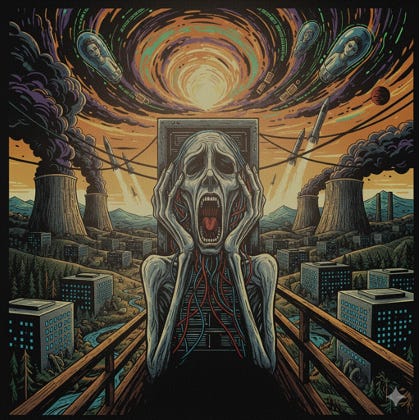
Last week, Sam Altman of OpenAI issued a “code red.” The Guardian reports that worthy competitors, like Google Gemini 3, were starting to eat ChatGPT’s lunch. The reflexive solution is neither collaboration nor optimization. AI dominance is a zero-sum, I-win-you-lose game. Instead, Altman’s solution is to build out Generative AI data centers with unprecedented speed and cost—safety be damned. Altman expects steep revenue growth by 2030 and has pledged to spend up to $1.4 trillion on data centers to train and operate its AI systems over the next eight years.
David Sacks, prominent denizen of Silicon Valley and close associate of Thiel, Andreessen and Musk, is currently ensconced as the “White House A.I. & Crypto Czar.” He serves as an unpaid “special government employee” looking after the interests of Silicon Valley. The position requires no Congressional confirmation. According to the New York Times, conflicts of interest—particularly those that could benefit Sacks’s own investments—are routinely brushed aside. Thanks to this special government employee, AI and crypto investors are thriving.
Elon Musk was also a special government employee. We know how well that worked out for American citizens. Eliminating waste, fraud, and abuse was never the point. Instead, we got waves of fired civil servants, crippled government agencies, decimated departments, and starving kids worldwide. Newsflash: Musk may be gone from the scene collecting his trillion dollar salary from Tesla, but DOGE is still embedded throughout the federal government. It’s sticky presence is reminiscent of a Matt Taibbi description that turned a lot of heads years ago.
“…a great vampire squid wrapped around the face of humanity,
relentlessly jamming its blood funnel into anything that smells like money.”
Munch.
AI data centers gobble up land, water, and energy. Cloud computing data centers built prior to 2022 were designed to manage daily digital needs like email, photo storage, streaming, and online shopping. They are now dwarfed in every way by hyperscale AI data centers.
Old fashioned cloud computing data centers draw 20-50 megawatts of power and occupy 10 to 30 acres of land. The heat load is cooled by ambient air.
Today’s hyperscale AI data centers draw 200-1000 megawatts of power and occupy 500 to 800+ acres of land. Immersion cooling requires millions of gallons of water. One facility alone can consume up to 5 million gallons of water every day. As much as 75% of that water is lost to the atmosphere and never returns to local watersheds. Impermeable surfaces of high-density, steel-reinforced concrete slabs and asphalt paving over vast data center footprints prevent natural aquifer recharge.
The difference between the two types of facilities is exponential. Explosively exponential. Hyperscale growth is accelerated by multiple competitors building simultaneously. AI data centers will be overbuilt and perhaps become obsolete eventually—but only after the environment has been irreversibly plundered.
Munch.
People are paying the price for this massive resource consumption. Loss of land. Loss of water. Compromised electrical grids. AI data centers are located using the principle of “place-based inequality.” Tech companies target rural and low-income areas—places with limited political capital—offering what appear to be lucrative incentives that rarely pay off.
Then come the health risks. As health-care coverage and Medicaid collapse in rural and low-income communities, air pollution from data-center activity is driving respiratory illness upward—asthma, COPD, cardiovascular strain. Noise pollution from 24/7/365 operations triggers sleep disruption and mental health disorders. A Caltech study warns premature deaths from data center air and noise pollution are projected to rise.
Munch.
Silicon Valley will take care of its own. There is an entire culture of tech billionaires preparing to go off-grid before the grid burns out. They will flee to multi-million dollar bunkers. Or they will found privatized land and sea-based Network States—a very underreported phenomenon. Or, with the right ticket, they will launch off to promising new planetary colonies. Some are hedging their bets via cryonics, hoping to be frozen at death in order to be roused in a distant future where their plundering of Planet Earth will be a faint memory.
The belief system behind all of this is a scary new techno-religion sweeping across Silicon Valley. It is encapsulated in a single acronym: TESCREAL
Transhumanism, Extropianism, Singularitarianism, Cosmism,
Rationalism, Effective Altruism, and Longtermism
This constellation of ideologies provides what its proponents view as the intellectual and “moral” scaffolding for prioritizing Artificial General Intelligence, which will confer radical life extension, space colonization, and a post-human future—even when those pursuits create massive harms through environmental degradation, unemployment, global health consequences, and the erosion of political freedoms.
Tech elites insist they have answers for everything. Their answers just may not include the rest of us.
Munch.
In July of this year, at the urging of David Sacks, Donald Trump signed an executive order accelerating the construction of hyperscale data centers.
Then he handed David Sacks the presidential pen.
Munch.
Selected Reading
Durán, Gil. The Nerd Reich: Silicon Valley Fascism and the War on Democracy. Simon & Schuster, due in 2026.
Soares, Nate. If Someone Builds It, We All Die: The Dangerous Philosophy of Accelerated AI. MIT Press, 2024.
Becker, Adam. More Everything Forever: How the World’s Richest Men Are Trying to Buy Eternal Life and Infinite Power. Dey Street Books, 2024.
Hao, Karen. Empire of AI. Crown, 2024.
Bracey, Catherine. World Eaters: How Venture Capital Is Cannibalizing the Economy. Doubleday, 2024.
Karpf, Dave. “The Failsons of the Network State.” The New Republic, May 25, 2023.
Harrington, Brooke. Offshore: Stealth Wealth and the New Colonialism. Princeton University Press, 2016.
Borsook, Paulina. Cyberselfish: A Critical Romp Through the Terribly Libertarian Culture of High Tech. PublicAffairs, 2000.
Learn more about TESCREAL on Gil Durán’s Nerd Reich podcast “Silicon Valley’s Scary New Tech Religion”
Wonderful!