
Sandra Died

Sandra died. Two years ago today. The void still hurts.
We met at Michigan State University. Sandra stood just an inch or two taller than my 4’11 mother. She towered in the eyes of a community trying to make sense of a compromised campus in a screwed-up world.
Within weeks, Sandra told me a story that defined who she became. Growing up Black in Jim Crow Alabama, she needed to speak to her brother who worked in a country club kitchen. She marched through the front door and asked for him by name. Before she could finish, a group of white people hustled her back out and pointed to the sign: “Service Entrance in Back.”
My first year at MSU was a blur of newfound freedoms, all-nighters, panty raids, fraternity pledging, swallowing goldfish, antiwar unrest. It wasn’t until my second year that the fog of university life began to roll back on the place I would call my alma mater. I moved off campus and went off script. Something wasn’t right. I wandered into the Center for Urban Affairs at the urging of a friend. I was starting to pay attention. That’s when I met Sandra.
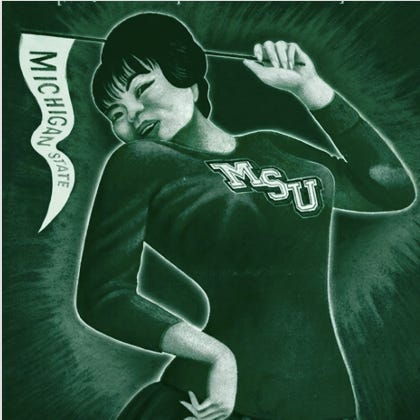
Sandra told me all about the university we attended. In 1966, Ramparts magazine exposed what the university had built in Vietnam between 1955 and 1962—the machinery of repression under U.S.-backed dictator Ngo Dinh Diem. MSU’s Vietnam Advisory Group had been a CIA cover embedded within the police administration division. Five agents conducted counterespionage and counterintelligence, complete with polygraph machines and bugged cells. MSU didn’t just advise Diem. MSU built the machinery he used to repress his own people. MSU President John Hannah had deep ties in Washington as a former assistant secretary of defense. He called the Ramparts article “pure fantasy.” Faculty perpetrators later confirmed it. The exposé has never been disproved. Madame Nhu, Diem’s sister-in-law aka Vietnam’s First Lady, earned her place on the Ramparts cover as a callous MSU cheerleader of oppression.
Against these revelations, Martin Luther King Jr. delivered “Beyond Vietnam” at the majestic Riverside Church in upper Manhattan. April 4, 1967. He called the U.S. government “the greatest purveyor of violence in the world today.” The speech, vastly differed from his 1963 “I Have a Dream” oration and ruptured the relationship between King and LBJ. Johnson felt betrayed. He had paid dearly in political coin to mint the Voting Rights Act in 1965 and considered himself the Civil Rights President. King gave no quarter. His speech claimed that civil rights, poverty, and war are not separate issues. They are interconnected manifestations of the same violence against Black people. The U.S. government—not the Viet Cong. Not the Soviets. Not China—was the greatest purveyor of violence. It was then that Johnson unleashed J. Edgar Hoover’s FBI spooks on King. King would be assassinated exactly one year after his “Beyond Vietnam” speech. April 4, 1968.
Sandra and I had a mutual friend working in the Dean of Students Office. People talked. She heard that the FBI met with the dean and showed him film of our friend and another student activist standing on the median of Grand River Avenue. Talking. He wanted to confirm that the film showed bona fide students and not plotting outside agitators.
After summer vacation, a housemate of mine said her parents were visited by two FBI agents at her Philadelphia home. They wanted to know more about me. Why was I running a popular simulation game called Star Power with so many members of SDS present? It was all part of a weave—a government convinced that protest meant violence, communism, and un-American activity.
Sandra understood what King understood. Civil rights, poverty, and the antiwar movement were the same struggle. The establishment disagreed. The NAACP disagreed. The New York Times, The Washington Post, and 168 newspapers across the country piled on King denouncing his speech. But I was on a campus that proved King right. MSU and the federal government had built police states abroad and brought the expertise home. The struggles weren’t separate. They never had been.
It was against this backdrop that Sandra created a group of workshop trainers at the Center for Urban Affairs. I was one of them. Sandra gave us the tools we needed. She trained us as facilitators. She taught us how to help people interrogate authority and question institutional narratives for themselves. We traveled around the state with the Michigan Education Association to K-12 schools helping white educators recognize their privilege and see how systemic racism operates in classrooms. The trainers were all white. That was the plan endorsed by SNCC, the Student Nonviolent Coordinating Committee. It was up to white people to dismantle white supremacy in white communities. It wasn’t up to Black people. If it were, Black people would be doing all the accommodating—making all the concessions. This was work for white people with white people.
Our workshops weren’t designed as feel-good exercises. They made people uncomfortable. That was the point. For white people who claimed to be allies in the fight against racism, there was one job: go deal with white people. Knock them off center. And that’s what we did. Tom Paxton’s 1964 song “What Did You Learn in School Today?” mocked the lies fed to children: that Washington never lied, soldiers seldom died, policemen are my friends, justice never ends, the government must be strong, always right and never wrong. That’s what we taught in school today. Still do.
Sandra never attended any of the workshop sessions. She had been hustled to service entrances too many times in her life—in Jim Crow Alabama and in Michigan, where the rules were unwritten but just as rigid. East Lansing was one of many places suspected of being a “sundown town.” No Blacks after dusk. This was never codified in writing, but I have friends who can verify it.
As the years crept along, those of us who lived off-campus together began making future plans. Some went to grad school. Some became civil rights organizers or public defenders. Some ran for office. Some taught. All hoping to make a difference. While we lived together, and until we departed, we would tune into the CBS Evening News with Walter Cronkite each night. Walter would sign off every broadcast with his signature, “And that’s the way it is…” We suspected it was a lie. Later it was confirmed. In a brilliant ploy by the Pentagon, Vietnam War death tolls, kill ratios, and daily maneuvers were sent directly to Walter who read them on-air without confirmation. The numbers and maneuvers were cooked to make it appear that victory in Vietnam was within reach. The Pentagon had no spokesman. Walter was their spokesman, passing along Pentagon data as fact—at least until the Tet Offensive when he travelled to Vietnam and pronounced the place “mired in stalemate.”
Sandra knew. At the end of every broadcast she would mutter, “that man should be busted for bullshit.” Two years on, I miss my touchstone.
These are some of the Courtside Warriors holding the line on authoritarianism— fighting to save democracy—and winning. Sign up for their newsletters. Support them if you can. They are joined by Attorneys General in 24 states who have won more than 80% of their cases against the authoritarian regime.
Democracy Forward, Public Citizen, Protect Democracy, Democracy Docket, League of Women Voters, Campaign Legal Center, ACLU, NAACP Legal Defense Fund, Citizens for Responsibility and Ethics in Washington, Democracy Defenders Fund, Brennan Center for Justice, Common Cause There are many more.
The Courts—Especially the Supreme Court—Won’t Save Us.
Nevertheless, we’ve got to support our Courtside Warriors any way we can.
Just Security Litigation Tracker
On January 29, 2025 there were 24 legal challenges
to Trump Administration actions.
As of May 20, 2026, there are now 802…and countingThanks for reading Musing! Subscribe for free to receive my posts each week.
Tears for Sandra and tears for your loss but she gave you the "eyes" for your Journey. This piece is the saddest and most glorious piece you've written. Jinx would be so proud. There is still so much work to be done.