
Unsung
Ketanji Brown Jackson and the Shadow Docket

“Justice without force is impotent;
force without justice is tyrannical.”
—Blaise Pascal
We are drowning in both halves of Pascal’s equation simultaneously—the tyranny of what is being done by an executive branch that declares contempt for every constraint placed upon it, and the impotence of everyone documenting the damage. We read and hear over and over again about which executive orders issued by the White House are illegal; which actions are unlawful. But without the power to enforce the law, calling a thing unlawful is itself impotent. As a result, even the most righteous citizens are tuning out. We have months to go before the midterms and years before the next general election. We will no doubt hear more and more expressions of authoritarian contempt for every constraint the Constitution places on power — and plenty of paid pundits to tell us just how illegal they are.
Cable commenters, podcasters, columnists, scholars are calling things illegal and treating their diagnosis as a complete thought. Into that vacuum steps one voice that refuses to treat illegality as the end of the story: Justice Ketanji Brown Jackson. She recognizes that diagnosis is only the beginning. Being illegal without remedy is just noise — impotent noise. Her accumulating dissents are simultaneously minority opinion, historical record, public education, and blueprint for future remedy. When remedies are eventually restored—by a future court, a future Congress, a future moment of institutional accountability—Jackson’s roadmap will already exist on the record.
“You hope to be writing for posterity, because you would hope that eventually
your point of view would prevail.”—Justice Ketanji Brown Jackson
Many of the most consequential Supreme Court decisions are made in the dark, through what legal scholars call the shadow docket.
Trump v. CASA was decided on the shadow docket. The first federal judge to weigh in, Senior U.S. District Judge John Coughenour of Seattle, called Trump’s executive order ending birthright citizenship “blatantly unconstitutional”—and every court that followed agreed, enjoining its enforcement and preventing the administration from stripping citizenship from anyone—even those who had not sued.
The 6–3 Supreme Court conservative majority reversed all that. It gutted the nationwide injunctions that served to protect an estimated 150,000 children born each year—children who would lose that protection under Trump’s order. The Supreme Court majority declined to rule on whether Trump’s order was constitutional. It simply stripped lower courts of the power to protect anyone beyond the named plaintiffs in each individual suit.
The result, as Jackson wrote in dissent, was a “zone of lawlessness” in which the Constitution means one thing for citizens who can afford to sue, and something else entirely for those who cannot.
“The Court’s decision to permit the Executive to violate the Constitution with respect to anyone who has not yet sued is an existential threat to the rule of law.”
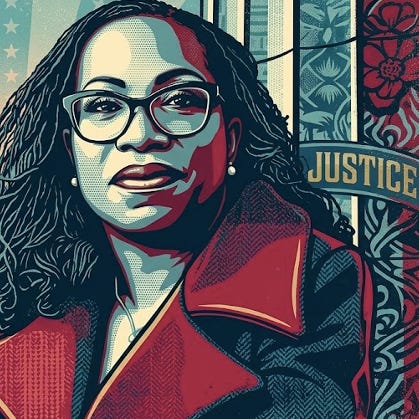
Justice Jackson understood that Trump v. CASA was not about birthright citizenship. It was about whether “unlawful” has any operational meaning. She argued further:
“When the Government says, ‘do not allow the lower courts to enjoin executive action universally as a remedy for unconstitutional conduct,’ what it is actually saying is that the Executive wants to continue doing something that a court has determined violates the Constitution — please allow this. That is some solicitation.”
Trump v. CASA was pulled into the public eye because the Supreme Court chose to hear oral arguments on the procedural question of whether nationwide injunctions are constitutional—while still declining to rule on whether the executive order itself violated the Fourteenth Amendment. Once exposed, Justice Amy Coney Barrett felt obliged to answer Justice Jackson’s dissent with a swat.
“We will not dwell on Justice Jackson’s argument. Justice Jackson decries an imperial Executive while embracing an imperial Judiciary. No one disputes that the Executive has a duty to follow the law. But the Judiciary does not have unbridled authority to enforce this obligation—in fact, sometimes the law prohibits the Judiciary from doing so.”
The majority’s stated concern was judicial overreach—nationwide injunctions running amok. Jackson reframed the question as something simpler and more damning: a grant of permission for the Executive to violate the Constitution for everyone who cannot afford to sue. Jackson’s reply embedded in her dissent cut to the bone.
“Courts must have the power to order everyone (including the Executive)
to follow the law—full stop.”
Pascal’s equation lives in that exchange — justice demanding force, force demanding accountability.
This debate isn’t confined to the silence of the written record. Jackson is increasingly taking it public, most recently during a rare, direct exchange with Justice Brett Kavanaugh at a Washington judicial lecture. This wasn’t merely an academic exercise; it was Jackson carrying the case against the shadow docket into the room where some of its defenders sat.
It was an unusual setting — sitting justices rarely debate each other’s views in public—and Jackson used it to push further than any written dissent had taken her. She argued that trial courts are now making decisions in anticipation of shadow docket reversals, creating—her words—”a warped proceeding” that distorts justice at every level below the Supreme Court.
Jackson’s remark drew applause from the audience. It was a rare instance of the public, rather than Supreme Court Justices, being given the last word.
Kavanaugh did his best to counter Jackson but conceded that “none of us enjoy this.” Reasonable citizens might inquire: “If none of you enjoy this, then why do six of you keep doing it?” And further, “why so often?”
The Trump administration has filed 34 emergency shadow‑docket applications in the first months of this presidential term. Biden filed 19 during his entire four-year term. Eight were filed during the combined sixteen years of the Obama and Bush administrations. And the shadow docket results so far this term? The Supreme Court has ruled at least partially for the Trump administration in 80% of the cases. Barrett’s dismissal of Jackson as an advocate for an “imperial judiciary” must be weighed against these numbers. Barrett took her swipe at Jackson in a written opinion. She was not in the audience when Jackson’s critique drew applause from the room.
We all anticipate the Supreme Court term end decisions coming in June. The future of birthright citizenship and the Voting Rights Act loom large. We will see whether these decisions serve the people of the United States or not. However they fall, we can be sure that Justice Ketanji Brown Jackson, the unsung hero of the Supreme Court, will be writing dissents that name the lawlessness, map the remedy, and demand that someone, someday, answer for it. Justice Jackson is writing for us. She is assuring tens of millions of people who are not lawyers that, no, we are not wrong to question the good faith of a Supreme Court with a six-justice conservative majority that has repeatedly sided with a Republican president in high‑stakes emergency shadow docket cases. Justice Jackson will offer her opinions and dissents on behalf of the people. We owe her our gratitude. As Jessica Clark, a constitutional law professor at the University of Southern California observed, Justice Jackson “is trying to explain to an audience beyond her colleagues what’s happening right now, and she’s asking that we all pay attention.”
These are some of the Courtside Warriors holding the line on authoritarianism— fighting to save democracy—and winning. Sign up for their newsletters. Support them if you can. They are joined by Attorneys General in 24 states who have won more than 80% of their cases against the authoritarian regime.
Democracy Forward, Public Citizen, Protect Democracy, Democracy Docket, League of Women Voters, Campaign Legal Center, ACLU, NAACP Legal Defense Fund, Citizens for Responsibility and Ethics in Washington, Democracy Defenders Fund, Brennan Center for Justice, Common Cause There are many more.
The Courts—Especially the Supreme Court—Won’t Save Us.
Nevertheless, we’ve got to support our Courtside Warriors any way we can.
Just Security Litigation Tracker
On January 29, 2025 there were 24 legal challenges
to Trump Administration actions.
As of April 8, 2026, there are now 751…and counting
Excellent commentary, Harry - thank you!